Science Fair
How to Do a
Science Fair Project
What's an experiment?
Experiments are one way to answer questions. If you ask "How long does it take for an ice cube to melt?", you can do an experiment to find out. Take an ice cube out the freezer, put it in a bowl on the counter and time how long it takes to melt. That's the simplest type of experiment where you are watching a phenomenon.
That basic experiment can lead to more questions and more advanced experiments. After watching the ice cube melt, most will start to ask more questions. What could we have done to make the ice cube melt faster? What would make it melt slower?
One option at this point is to take a moment and create a hypothesis about ice cubes and melting. Set up a series of tests.
Whether you are creating a science fair project, using a hypothesis or just experiment for fun, let's define a few of the terms.
Independent variable - something that is changed in the experiment.
Dependent variable - something that responds to the Independent variable.
Constant Variable - something that is kept the same throughout the series of experiments.
Control - similar test where the independent variable is left unchanged to provide a comparison.
To continue with our ice cube melting experiment, the next question might be "Would the ice cube melt faster if it was in little pieces?" You could set-up a test where you have one ice cube that is broken into little pieces on one plate, and a whole ice cube on a plate beside it. Then you would time how long it takes each ice cube to turn into water.
The independent variable is the size of the pieces of ice, it changed between the two tests. One of the constant variables would be the temperature in the room, it stays the same for both tests. The control would be the whole ice cube that is melting. The dependent variable would be the time it takes the ice cube to melt. That variable is dependent on the size of the pieces of ice.
What if you had just taken out one ice cube, broken it into small pieces and timed how long it took to melt? Couldn't you have just compared it to the time it took the first ice cube to melt? Maybe. But the temperature in the room might have changed between the two experiments. By having a control (the whole ice cube) you are trying to control for other variables that aren't part of the experiment (temperature) but that could change your results.
If you are planning a series of experiments, the constant variable could become the independent variable in the next experiment. It just depends on the question you are trying to answer and the design of the experiment.
Just experiment in the beginning. But as you find out how fun and interesting it is to do science experiments, start to introduce some of the scientific principles and terms.
A control is often the most interesting part of the experiment. Often they will surprise the scientist by behaving different from what was expected.
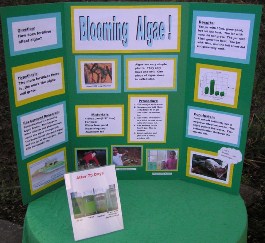
Experiments for a science fair need to follow a specific set of guidelines. The guidelines can vary between science fairs so be sure you have the correct information.
The display poster board is an important tool for the presentation of your research.
The objective of a display board is to present the main areas and conclusions of your project so that others can easily understand what you accomplished. This is not the same as your written report. The actual project will have a lot more detail that will be shown in your written report. Think of the display board as a commercial for your project. The commercial will state the main points and key features of your research so that others will understand what you did and how you did it.
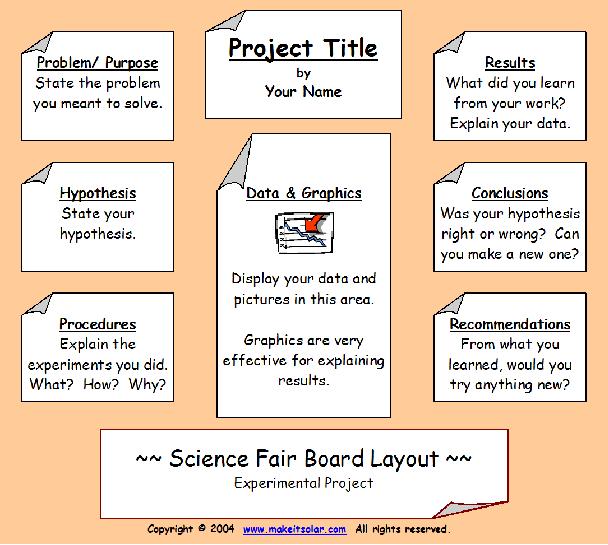
Like books, people will read your board from left to right and top to bottom. It is a good idea to arrange your project information so that observers can read your display in logical order. Part of your challenge is to make it easy for others to understand your work. The only section not following this convention is the title which should be located at the top center of your display.
The main areas of a poster board could be the ones shown in the chart on this page. The areas are explained below. Each section presented on the display board should be only one paragraph if possible. The actual areas you use will depend on the rules of your fair and the choice of exact information you want to present.
Check with your teacher or fair coordinator before using this format.
Title
The title of your project. Your name.
Data and Graphics
Present any significant data, graphs, and pictures in this section. Visual representations of your results, if done effectively, are worth thousands of words.
Problem/ Purpose
State the problem that you were originally concerned with and explain why you selected the topic you did?
Hypothesis
State your hypothesis.
Procedures
State the procedures you followed. What experiments did you perform and why?
Results
What did you find out from your data? Explain the results here.
Conclusions
Was your hypothesis right or wrong? Can you make a new statement that you know to be true based on your research?
Recommendations
From everything you learned would you make any recommendations for further research? Write your ideas for research in this section.
Other Display Materials
Abstract
An abstract is a brief overview of your project work. It should include the title, your name, and brief summaries of the problem, hypothesis, procedures, data and conclusions. It should be no more than one typed page with 1 or 2 paragraphs.
It is a good idea to have copies of your abstract available for visitors to take with them.
Models or Research Apparatus
Did you create any models or experimental setups that are important in explaining your work? Three dimensional objects and pictures are often more effective than words at communicating complex ideas. Find out from your teacher if it is appropriate for you to display models or apparatus and whether or not you can show them working.